


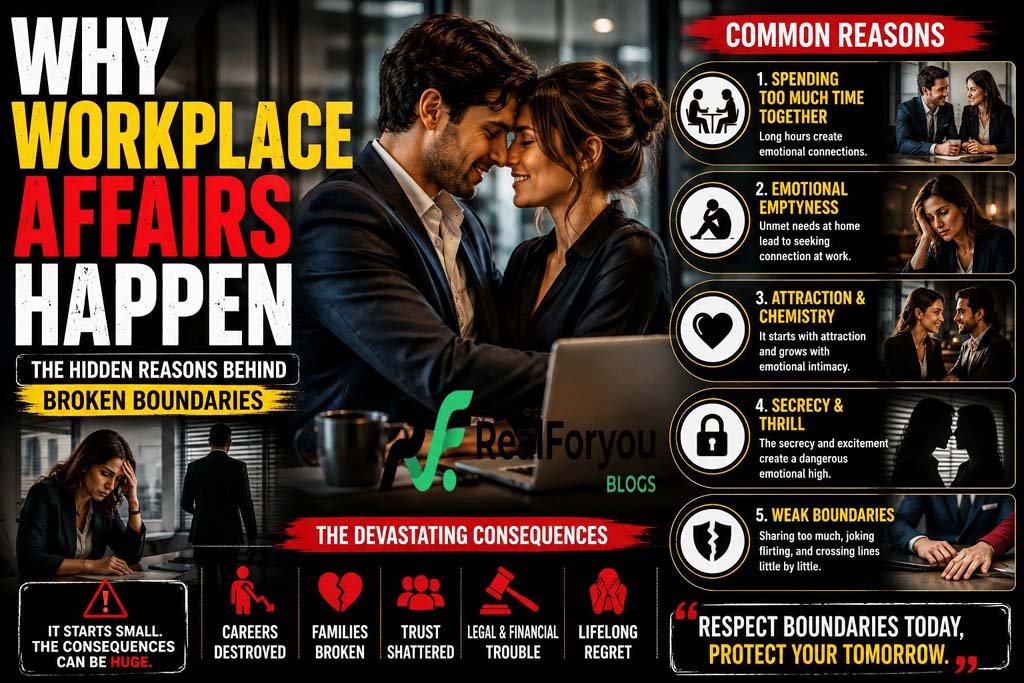
Office Affairs Unveiled: Real Stories of Love, Lust, and Consequences at Work
Introduction
The workplace is where many of us spend the majority of our waking hours. We share deadlines, coffee breaks, late-night projects, and sometimes, intimate connections. While office romances are nothing new, affairs between coworkers—particularly those involving infidelity—carry a unique blend of excitement, secrecy, and risk that can transform lives forever.
What drives people to risk their marriages and careers for a colleague? What happens when the affair is exposed? This article explores real accounts from people who have navigated the treacherous waters of workplace affairs, revealing the emotional highs, devastating lows, and lasting consequences that follow.

Why Workplace Affairs Happen
Statistics show that workplace relationships are remarkably common. According to a 2024 survey, approximately 60 percent of adults report having experienced a workplace romance during their lifetime, with 40 percent acknowledging they cheated on their current partner with a coworker . The reasons are straightforward: comfort, proximity, and shared experience.
Research identifies three primary drivers for workplace relationships. First, 65 percent of employees cite comfort and familiarity as key factors—being around someone daily, sharing challenges and victories naturally builds emotional intimacy.
Second, 61 percent say packed schedules leave little time to meet people outside work. Third, 38 percent find common ground in understanding each other’s professional pressures and goals .
What begins as emotional closeness can easily blur into something more, especially amid late nights, business travel, and high-pressure deadlines. Alarmingly, 85 percent of extramarital affairs originate in the workplace, according to compiled data .

The Allure and the Rush
Many who have engaged in workplace affairs describe an intoxicating mix of chemistry and secrecy. One woman shared how her affair with a chef at a high-end restaurant began with flirting and escalated into “full-on” passion.
Both were in committed relationships, yet they were “drawn to each other like moths to a flame.” Their encounters happened in hidden corners, cars before and after work, and any opportunity to touch or kiss . She admitted years later: “I’d probably sleep with him again if I saw him today because it was so hot.”
Another story involved a woman who began an affair with her husband’s boss after discovering her husband’s infidelity. She described the companionship and conversations that preceded their physical relationship, noting:
“It was incredible! He was very attentive and giving… It’s been so much fun that neither of us can believe how quickly a year has passed” .
The secrecy itself seems to amplify the intensity. When relationships must be hidden from spouses, HR departments, and curious colleagues, every stolen moment carries an adrenaline rush that can be addictive.

When Affairs Transform Into Lasting Love
Not all workplace affairs end in disaster. Some people find genuine, lasting love, even if the circumstances are complicated. One woman met her now-husband while both were married to other people and working at a zoo. Despite initial intentions to keep it a one-time encounter, their connection deepened.
“He was and will always be my person. I’ve never been in love like this and have never felt so loved by anyone in my life,” she shared .
Similarly, a man in a loveless marriage began an affair with a younger IT support colleague. Despite a 21-year age gap and professional risks, they fell hard for each other. He eventually divorced, and they remain together nine years later. His colleagues believe they simply “reconnected” after having mutual crushes years ago—a cover story he describes as “adorable” .

The Dark Side: Discovery and Devastation
For every success story, there are countless tales of heartbreak. When workplace affairs are exposed, the fallout can be catastrophic—not just for marriages, but for careers and mental health.
One woman discovered her fiancé cheating with his coworker on what should have been their wedding day. Walking into the home she had purchased for them, she found him naked and his coworker in the bedroom.
To make matters worse, she learned he had taken out a $500,000 life insurance policy on her during the affair . The betrayal was compounded by financial exploitation—a reminder that workplace affairs can have far-reaching consequences beyond emotional pain.
Another contributor described how an affair with a colleague led to devastating regret. After his wife’s passing, he admitted: “I miss my coworker more than my wife a decade after my wife’s passing.” While he only slightly regretted the affair itself, the emotional complexity lingered long after .

The Professional Consequences
Affairs don’t just damage personal lives—they impact careers. According to the Society for Human Resource Management, 57 percent of employees say workplace romance affected their work performance, and 54 percent report it altered their work-life balance .
When executives are involved, the stakes escalate dramatically. High-profile cases regularly make headlines: CEOs fired for violating company policies, board investigations into relationships with subordinates, and resignations that shake investor confidence.
As one employment lawyer noted: “Love and lust in the office isn’t illegal—it’s just usually not a good idea” .
Companies increasingly enforce strict policies, especially after the #MeToo movement. Many restrict managers from dating subordinates to avoid power imbalances and potential claims of favoritism or harassment .
Some organizations require “love contracts”—formal acknowledgments that relationships are consensual—to protect against future litigation .
The workplace grapevine also takes its toll. Colleagues often sense secrets before they’re confirmed, creating distrust and gossip that can poison team dynamics . As one psychologist observed: “When there’s an intimate relationship happening in a team and it’s being kept as a secret, people pick up on it intuitively” .

Why Disclosure Matters
One of the most challenging questions for those involved in workplace affairs is whether to disclose the relationship to HR. Approximately 82 percent of employees keep workplace romances secret .
The reasons are understandable: fear of judgment, concerns about career repercussions, and the awkwardness of formal disclosure.
However, secrecy carries its own risks. When relationships remain hidden, they can create conflicts of interest, raise questions about favoritism, and damage trust within teams. For executives, failure to disclose can lead to termination when the relationship inevitably comes to light .

When Work Becomes a Battlefield
The aftermath of a workplace affair can be excruciating, especially when both parties must continue working together. One woman described how she and her affair partner “sneak around” despite his reputation for infidelity.
“I know I need to let him go, but I’m in love. I know I could never trust him,” she admitted . For her, the workplace remains a constant reminder of a relationship she can’t fully embrace or escape.
Another contributor noted the torment of seeing her affair partner daily after their breakup. “This woman ruined me, and I still see her every day. Regrets are abundant in my daily life” .
The inability to achieve emotional distance while maintaining professional obligations creates ongoing stress that affects performance and well-being.

Is It Worth the Risk?
Statistically, workplace relationships have a reasonable success rate—43 percent end in marriage . However, the path to that outcome is rarely smooth, and the risks for those already in committed relationships are particularly high.
For anyone considering a workplace affair, experts recommend: approaching with emotional intelligence, setting clear boundaries, and having a plan for what happens if the relationship ends .
Companies, meanwhile, are urged to respond with neutrality rather than judgment, recognizing that workplace relationships will continue regardless of policies .
Conclusion
The stories shared by those who have experienced workplace affairs reveal a complex tapestry of human emotion: thrilling connection, devastating betrayal, unexpected love, and lasting regret. While some find partners for life, others face shattered marriages, damaged reputations, and careers derailed by poor judgment.
What emerges clearly is that workplace affairs are never simple. They intertwine professional and personal lives in ways that make disentanglement extraordinarily difficult. The same office that brought two people together can become a source of ongoing pain when the relationship falters.
Perhaps the most important lesson is that transparency and intentionality matter. Whether through disclosure to HR, clear boundaries, or honest conversations with partners, those who navigate workplace relationships with integrity stand a better chance of avoiding the worst consequences.
For everyone else, the stories serve as cautionary tales: the person across the cubicle may seem irresistible, but the price of that attraction can be far higher than anyone anticipates.
Author’s Perspective
I decided to write this article because workplace relationships are becoming more common, yet the emotional and professional consequences are often overlooked. Stories about office affairs frequently make headlines, but they rarely explain why these relationships begin, how they affect the people involved, or what lessons others can learn from them. I wanted to explore those questions in a balanced and thoughtful way.
While researching this topic, I found that every story was different. Some people described finding lasting love, while others spoke about broken trust, damaged careers, and emotional regret. These experiences reminded me that every decision has consequences, especially when personal relationships become connected to professional life.
My goal was not to judge anyone but to help readers better understand the realities behind workplace affairs. I hope this article encourages people to think carefully about their choices, respect workplace boundaries, and value honesty in both their personal and professional relationships. By sharing real experiences and reliable information, I aim to create content that informs readers and inspires thoughtful conversations.
Written by: Dua Qamar
