


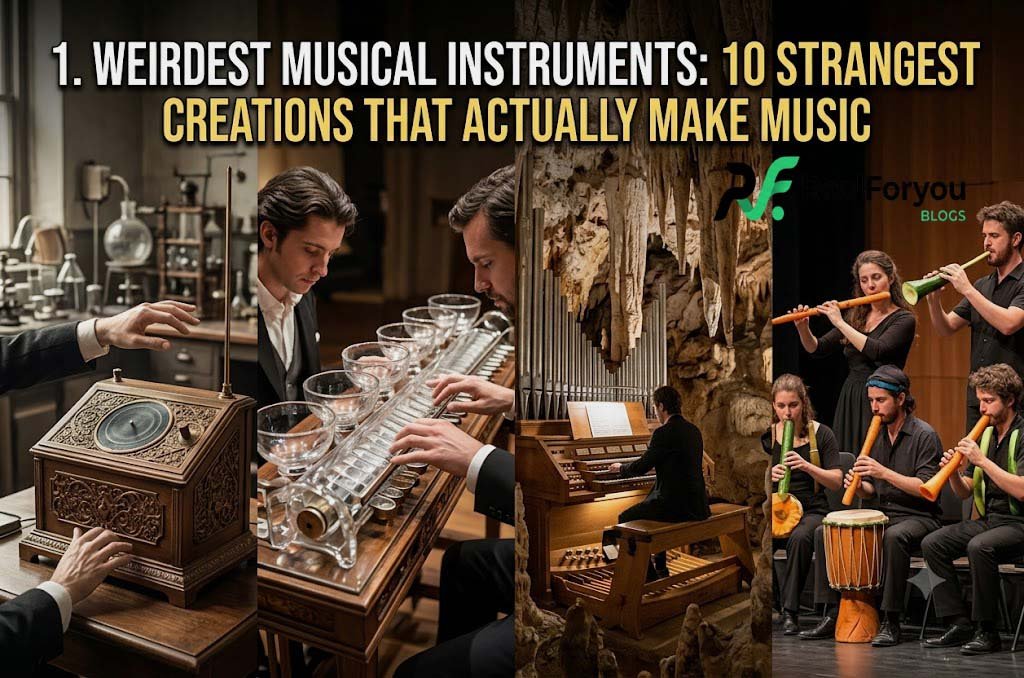
10 Weirdest Musical Instruments In The World
Introduction
When we think of musical instruments, familiar images come to mind: the elegant curves of a violin, the sleek keys of a piano, or the classic shape of a guitar. But the world of music is far stranger and more creative than most of us realise. Throughout history, inventors and musicians have pushed the boundaries of sound, creating instruments that defy logic, challenge tradition, and sometimes even raise eyebrows .
From instruments played without touching them to those powered by fire, here are ten of the weirdest musical instruments ever created.
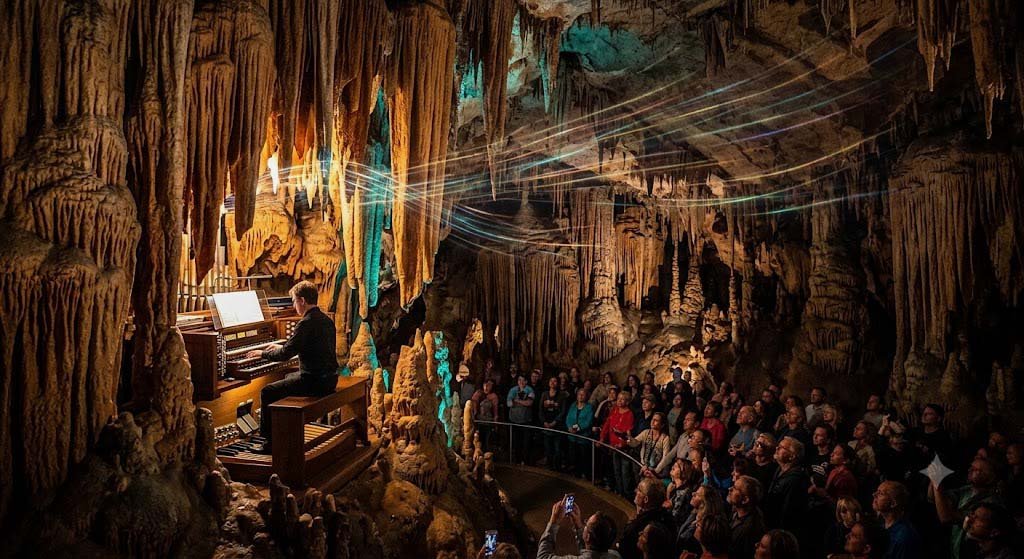
1. The Great Stalacpipe Organ
Deep within Virginia’s Luray Caverns lies what might be the oldest and most unusual instrument on Earth. The Great Stalacpipe Organ is a lithophone that turns the cave itself into a musical instrument. In the 1950s, mathematician and electronics scientist Leland W. Sprinkle spent three years selecting and shaping ancient stalactites to produce precise musical tones . Electronic mallets connected to a keyboard strike these geological formations, producing ethereal, echoing sounds that resonate through the cavern’s natural acoustics. The result is an instrument that feels prehistoric yet futuristic.
2. The Theremin
The theremin is famously the only instrument played without physical contact. Invented in 1920 by Russian scientist Léon Theremin, it features two metal antennas that sense the position of the player’s hands . One hand controls pitch, the other volume, and by moving through invisible electromagnetic fields, players create eerie, wavering tones. Its unique sound made it a favourite in 1950s science fiction films, and it even found its way into popular music—most notably in The Beach Boys’ “Good Vibrations” . Interestingly, the Soviet Union originally tasked Theremin with developing motion-sensing security technology; he invented a musical instrument instead .
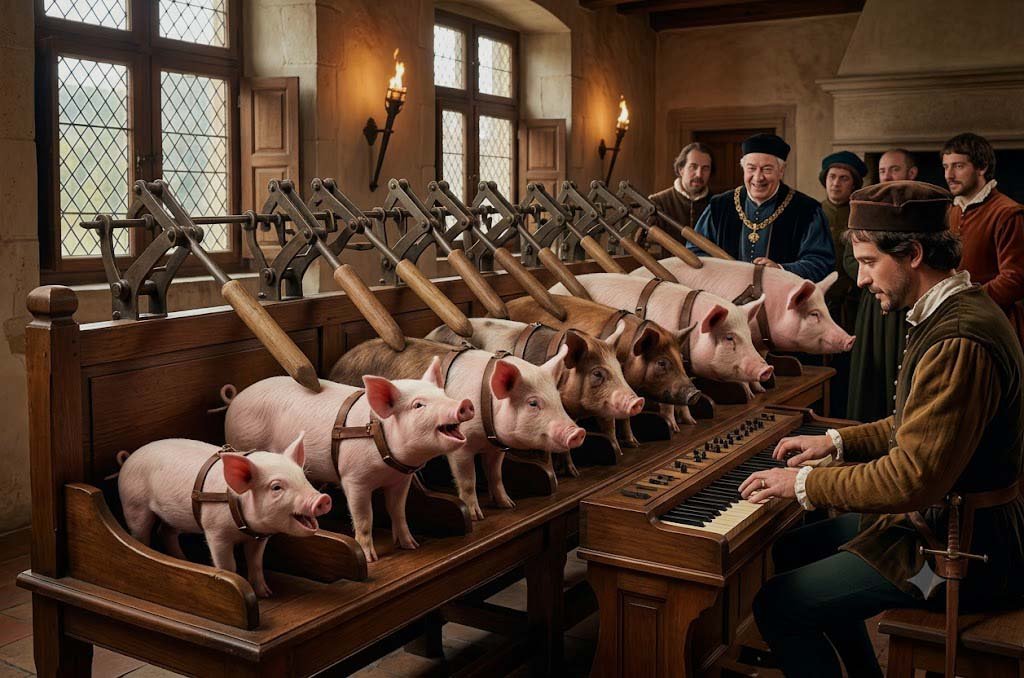
3. The Piganino
Perhaps the most bizarre instrument in history is the Piganino, also known as the Hog Harmonium or Schweineorgel. In the 15th century, King Louis XI of France challenged his music master to create a piano-like instrument using pigs. The result was a row of pigs, arranged from smallest to largest, with spikes positioned above each animal’s hindquarters. Pressing a key poked the corresponding pig, causing it to oink in its natural voice—creating a crude, melodic sequence of squeals . Louis was reportedly delighted, though the pigs were likely less amused.
4. The Pyrophone (Fire Organ)
The pyrophone, invented by Frenchman Georges Frédéric Eugène Kastner in the 19th century, is exactly what it sounds like: an organ powered by fire. Controlled explosions and flames ignited inside glass tubes produced loud, unsteady sounds . Also known as the “explosion organ,” it never became a mainstream instrument, but it perfectly captured an era when inventors eagerly blended science, technology, and art. Its fiery operation made it more of a curiosity than a practical instrument.
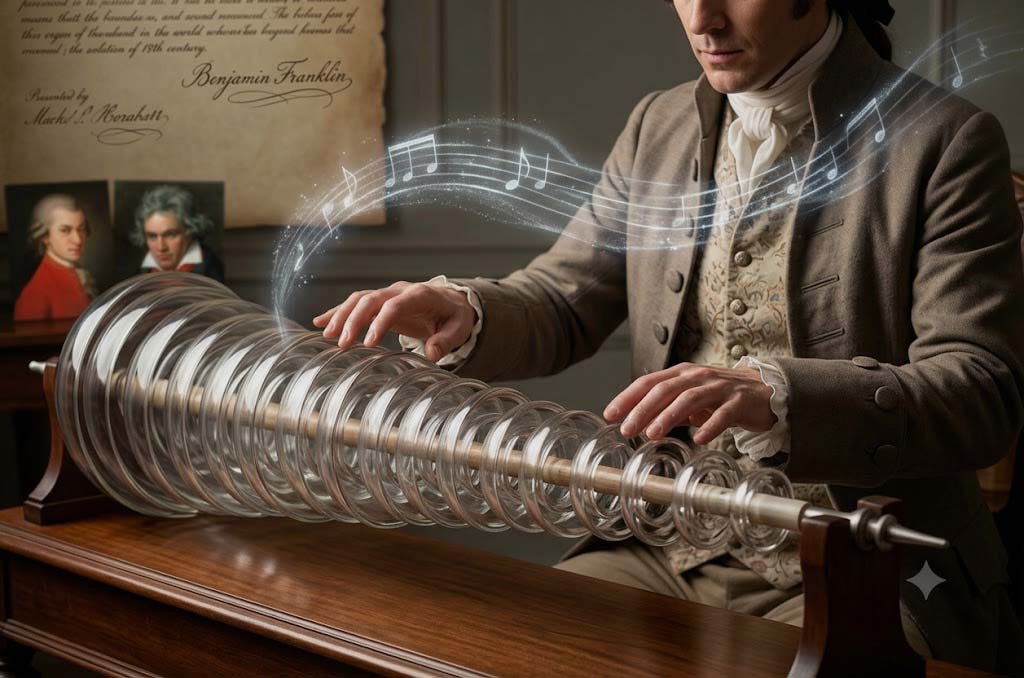
5. The Glass Armonica
Benjamin Franklin, the American founding father, invented the glass armonica in 1761 after witnessing a performance where a musician played tuned wine glasses . He improved the concept by mounting glass bowls on a rotating spindle, allowing the musician to play multiple notes at once. The instrument produces haunting, ethereal tones that inspired Mozart and Beethoven to compose for it . However, it also gained a dark reputation—rumours spread that its ghostly sounds could drive listeners mad, disturb sleep, or even summon spirits . By 1830, the glass armonica had fallen out of fashion.
6. The Serpent
The serpent, a bass wind instrument that first appeared in the 16th century, is named for its snake-like wooden body. It has finger holes like a woodwind but produces the deep tones of a brass instrument . Originally designed to provide bass support for church choirs, its ungainly shape and fluctuating tone made it notoriously difficult to play. Composer Hector Berlioz described its sound as “essentially barbaric” and “cold and abominable howling” . Despite its strangeness, the serpent is considered the ancestor of modern tubas and euphoniums.
7. The Singing Ringing Tree
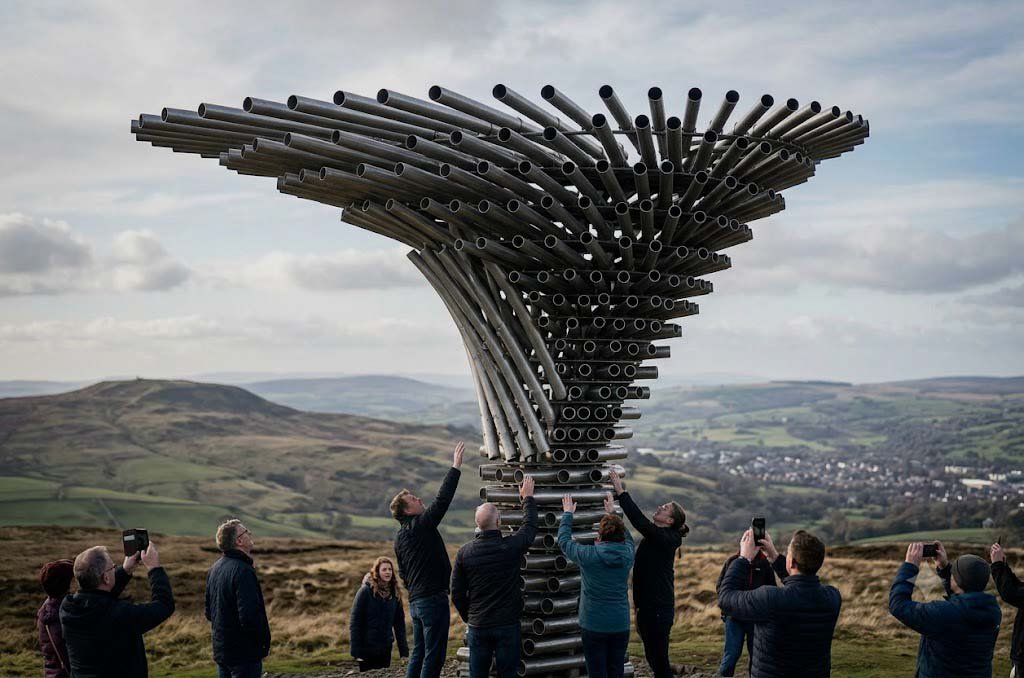
This is less a traditional instrument and more a wind-powered sculpture. Standing three metres tall on a hilltop in Burnley, England, the Singing Ringing Tree is made of metal pipes that produce ghostly, harmonic tones as the wind blows through them . Unlike most instruments, it is played by nature itself rather than a human performer. Completed in 2006, it serves as both a striking work of public art and a reminder that music can be as much about the environment as it is about human expression.
8. The Sharpsichord
The Sharpsichord, also known as the pin-barrel harp, is a massive, solar-powered instrument that works like a giant music box. Invented by Henry Dagg in the 21st century, it uses a rotating cylinder with thousands of holes where pins can be placed to pluck strings . Its design mixes old-fashioned mechanical principles with modern technology. The Sharpsichord is so unusual that it even appeared in a charity concert with Elton John.
9. The Vegetable Orchestra Instruments
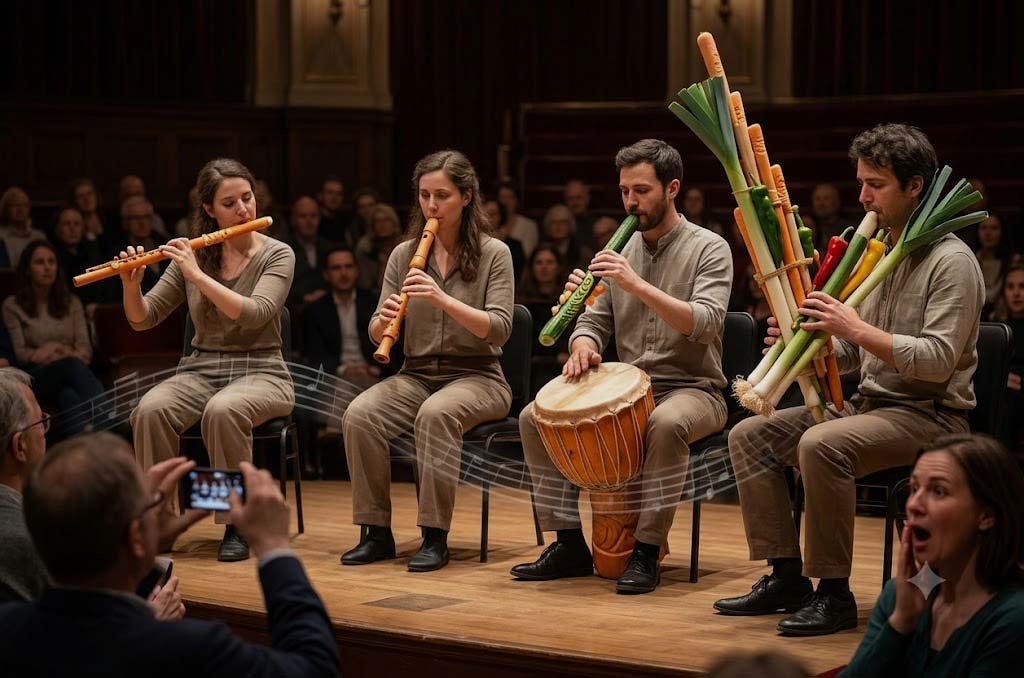
The Vegetable Orchestra of Vienna creates all of its instruments from fresh vegetables such as carrots, pumpkins, cucumbers, and leeks. Before each performance, members carve flutes, drums, and horns from produce . Founded in 1998, the ensemble combines humour with environmental awareness, challenging the idea of permanence in music. After each concert, the vegetables are used to make soup, which is then served to the audience—making this perhaps the only musical performance that ends with a communal meal.
10. The Nyckelharpa
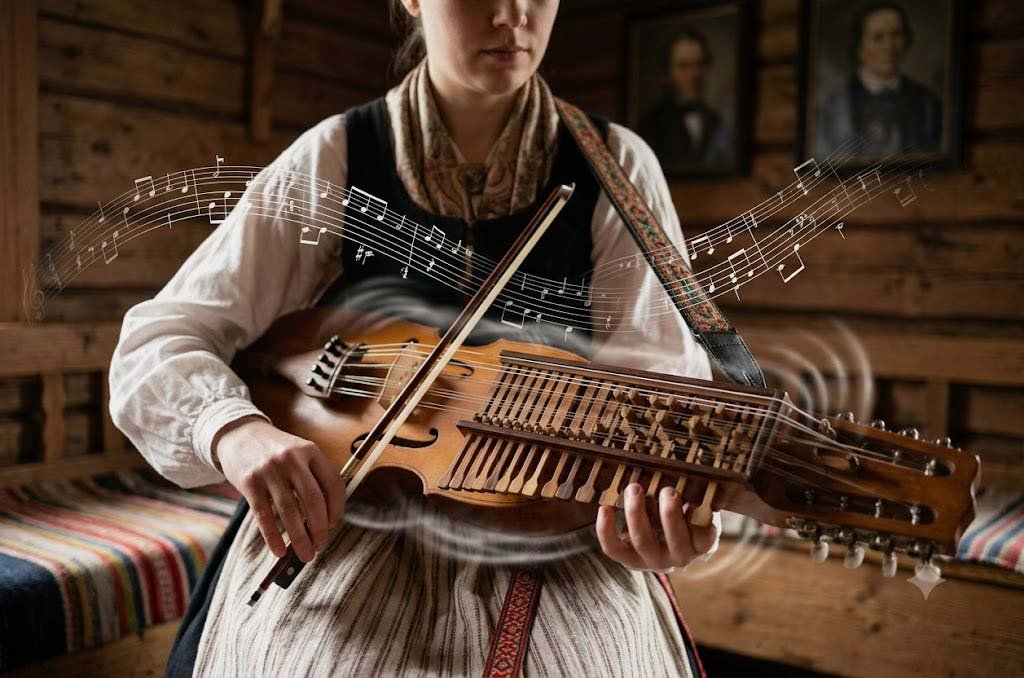
Often described as the “duck-billed platypus” of instruments, the nyckelharpa is a Swedish instrument with a 900-year history. It has four strings that are played with a bow, plus a dozen sympathetic strings that vibrate without being directly bowed, and a key box on the neck that produces notes . As one player noted, “the notes don’t move as fluidly as on a violin because of the keys, and you get the sound of the keys clacking, and the percussive buzz of the trompette drone. There really isn’t anything else quite like it” .
Conclusion
From pig organs to vegetable flutes, these ten instruments remind us that music has always been a playground for human creativity. Each represents a moment when someone asked, “What if?” and pursued the answer with passion and ingenuity. While many of these instruments never achieved mainstream popularity, they have left an indelible mark on the history of music, proving that the boundaries of sound are limited only by imagination.
About the Author
My name is Dua Qamar, and I am a content writer fascinated by the strange, the unusual, and the creative ways humans express themselves.
Why I Wrote This Article:
I wrote this piece because music is one of the most universal forms of human expression, yet we rarely think about how the instruments we play came to be. The stories behind these strange instruments are a reminder that creativity has no limits—and that some of the most interesting ideas come from people willing to think outside the box.
How I Approached This Topic:
My research involved exploring historical records, music publications, and cultural documentation to find the most unusual instruments from around the world. I focused on instruments that are not just rare, but also have fascinating stories behind their creation.
Who This Article Is For:
This article is for music lovers, history enthusiasts, and anyone who enjoys discovering the strange and wonderful corners of human creativity.
The Message I Hope Readers Take Away:
The most interesting innovations often come from those who dare to be different. The next time you hear an unusual sound, remember—someone had to invent it first.
Written by: Dua Qamar
