


16 Very Useful Mental Life Hacks and Tricks
Introduction
Your mind is one of the greatest assets you possess. It shapes your thoughts, decisions, and the way you experience life. However, many people never fully use its potential because they are unaware of simple psychological techniques that can make everyday life easier. Mental life hacks are not shortcuts or tricks to fool the system. Instead, they help you understand how your brain works so you can improve your focus, increase productivity, reduce stress, and enjoy life more.
From overcoming procrastination to building better habits and managing stress, here are sixteen powerful mental life hacks backed by psychology and neuroscience that can transform how you think, work, and live.

1. The 2-Minute Rule
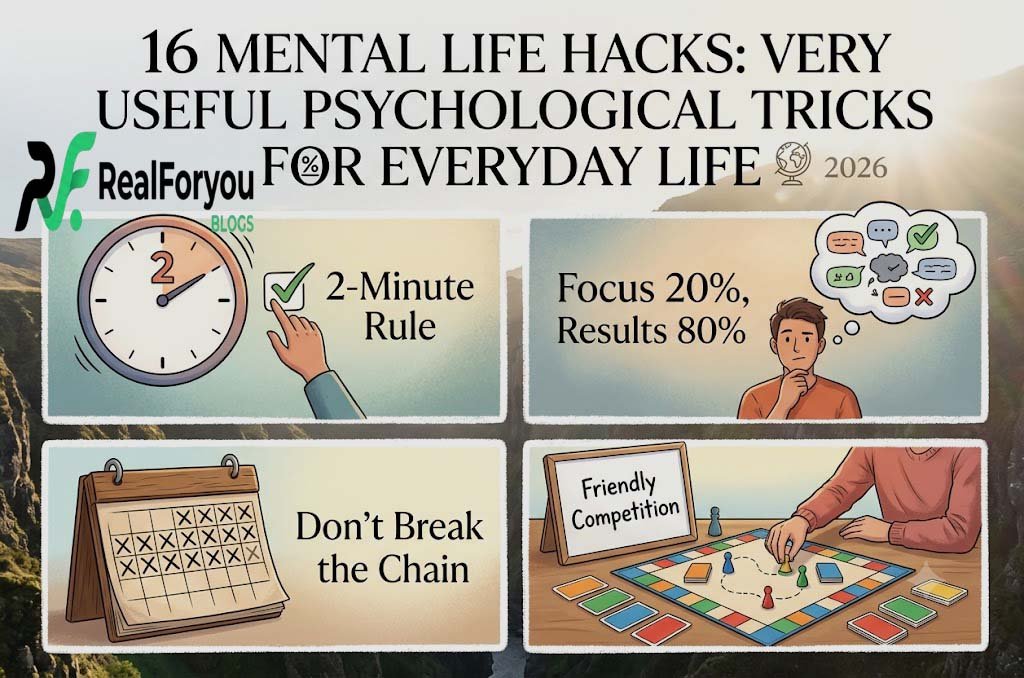
Whenever a task can be finished in under two minutes, complete it right away instead of postponing it. This simple rule, popularized by productivity expert David Allen, prevents small tasks from piling up and cluttering your mind. The psychology behind it is simple: the mental energy spent remembering and worrying about a tiny task often exceeds the effort required to just do it. Handling small tasks right away clears your mind and gives you more mental energy to focus on what matters most.
2. The 5-Second Rule
When you feel an impulse to act on a goal, you must physically move within 5 seconds or your brain will kill the idea. Mel Robbins, who popularized this hack, explains that the 5-second window is the time it takes for your brain to start making excuses. By counting down from 5 and physically moving toward your goal, you interrupt the procrastination loop and trigger immediate action.
3. The Pomodoro Technique
The Pomodoro Technique encourages you to work with full focus for 25 minutes, then take a 5-minute break. After completing four sessions, reward yourself with a longer break of 15 to 30 minutes. This approach matches your brain’s natural ability to concentrate for short periods, helping you stay productive while reducing mental fatigue and burnout. It trains your brain to focus intensely for short periods, making daunting tasks feel more manageable.

4. The Zeigarnik Effect
The Zeigarnik Effect is the psychological phenomenon where uncompleted tasks are remembered better than completed ones. Use this to your advantage by starting tasks you want to finish. Once you begin, your brain will create mental tension that drives you to complete the task. Starting is often the hardest part—once you do, your brain will push you to finish.
5. The “Don’t Break the Chain” Method
Popularized by comedian Jerry Seinfeld, this hack involves marking an “X” on a calendar for every day you complete a specific task. The visual chain of X’s becomes a powerful motivator—you won’t want to break it. It leverages our natural desire for consistency and progress, making habit formation more tangible and rewarding.
6. The 80/20 Rule (Pareto Principle)
The Pareto Principle suggests that about 80% of outcomes are often the result of 20% of the efforts or actions. Apply this to your life by identifying the 20% of your activities that produce 80% of your results. Focus your energy there. Whether it’s work tasks, relationships, or personal projects, this mental model helps you prioritize what truly matters and stop wasting time on low-impact activities.
7. The Power of Tiny Habits
Instead of trying to overhaul your life overnight, start with tiny, manageable habits. If you want to develop a reading habit, begin with just one page a day. If you want to become more active, start with a single push-up and gradually build from there. These micro-habits are so small that you cannot fail, and they build momentum. Over time, these tiny actions compound into significant change.
8. The “10-Minute Rule” for Procrastination
Whenever you notice yourself delaying a task, commit to working on it for just 10 minutes. Once you begin, you’ll often find it much easier to keep going. After 10 minutes, you can stop. In many cases, taking the first step is the biggest challenge. Once you begin, the momentum often carries you far beyond those 10 minutes. This hack tricks your brain into overcoming the initial resistance to starting.
9. The Power of Gratitude
Practicing gratitude helps train your mind to focus on the positive things in your life instead of what is missing. Make it a daily habit to write down three things you are grateful for, no matter how big or small. Studies show that practising gratitude increases happiness and reduces depression. It is one of the simplest yet most effective mental shifts you can make.
10. The “Tomorrow” Technique
Stop telling yourself “I’ll do it tomorrow.” Instead, mentally rehearse doing the task tomorrow. Visualize yourself doing it at a specific time in a specific place. This mental rehearsal makes the task feel more real and increases the likelihood that you will actually follow through. Your brain doesn’t fully distinguish between imagining something and doing it—use this to your advantage.
11. The “What Would I Say to a Friend?” Method
When you are stuck with a problem or feeling down, ask yourself: “What would I tell a friend in this situation?” We often treat other people with more kindness, understanding, and clear thinking than we give ourselves. This hack helps you step outside your own perspective and access better advice.
12. The Power of Breath
When you feel overwhelmed or anxious, your breathing becomes shallow. Taking slow, deep breaths helps activate your body’s natural relaxation system, reducing stress and helping you feel calmer. The 4-7-8 technique (inhale for 4 seconds, hold for 7, exhale for 8) is a powerful tool for instant calm.
13. The “First Things First” Rule
The human brain is most alert and capable of focused thinking during the first few hours after waking. Focus on your most important and demanding tasks at the beginning of your day when your energy and concentration are strongest. This ensures that your best energy goes to what matters most, rather than frittering it away on trivial tasks.
14. The “Give Yourself Permission” Method
If you are stuck creatively, give yourself permission to write or create something bad. The desire to achieve perfection can sometimes become overwhelming and prevent us from taking action or making progress. By allowing yourself to produce imperfect work, you remove the mental block and often end up with something far better than you expected.
15. The “Countdown to Action” Trick
When you need to do something you are dreading, count down from 5 and launch into action. This simple technique cuts through overthinking and taps into a primal reflex to act. It works because counting disrupts the cycle of excuses in your brain.

16. The “Future Self” Visualization
When faced with a difficult decision, visualize your future self looking back on the choice you are about to make. This mental time travel clarifies priorities and helps you make decisions that align with your long-term values rather than short-term comfort.
About the Author
My name is Dua Qamar, and I am a content writer passionate about psychology, personal development, and the science of productivity.
Why I Wrote This Article:
I wrote this piece because the gap between knowing what to do and actually doing it is one of life’s biggest challenges. These mental hacks are not magic—they are simple, practical techniques that use how our brains naturally work to help us get out of our own way. I wanted to share them with readers who, like me, sometimes need a little help overcoming their own mental barriers.
How I Approached This Topic:
My research involved studying psychological principles, productivity methods, and behavioural science from credible sources. I focused on hacks that are both scientifically grounded and practical to implement.
Who This Article Is For:
This article is for anyone who wants to boost their productivity, build better habits, and gain more control over their mind and life.
The Message I Hope Readers Take Away:
Small shifts in how we think can create massive changes in how we live. Start small, experiment with these techniques, and find what works for you.
Written by: Dua Qamar
